
Anemia Disrupts the Body’s Oxygen Supply Chain
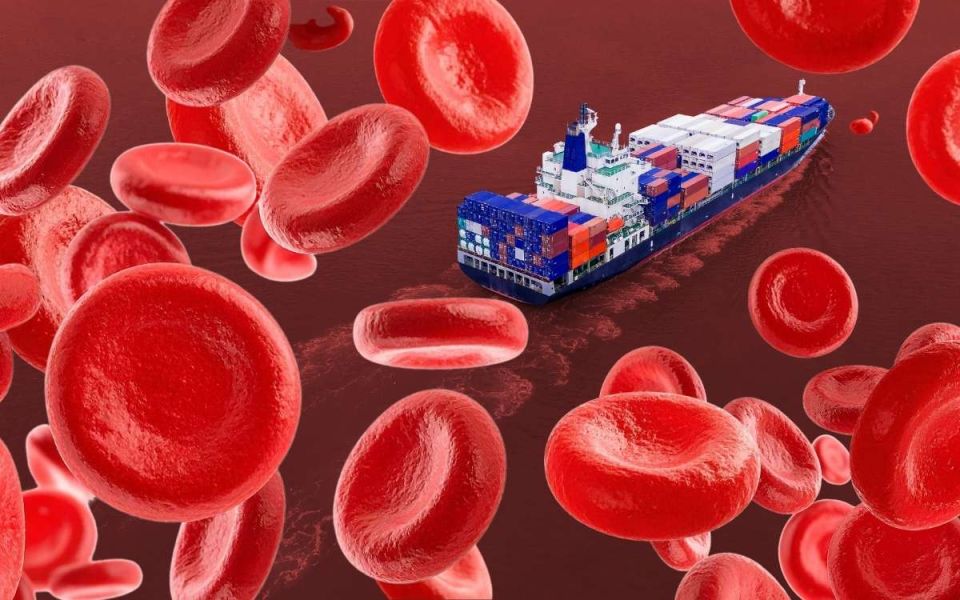
During the pandemic, we heard story after story about the supply chain. Ships were lined up outside the Port of Los Angeles. There were shortages of electronics, jewelry, and clothing, and prices rose across the board. The main stimulus, COVID-19, was a shock that broke a system of lean, just-in-time manufacturing that depended on precise timing with little wiggle room, and when push came to shove things fell apart quickly. One big problem was with shipping; container ships couldn’t be processed fast enough, and the ability to move critical items from place to place was severely compromised. The challenge of moving things from where they are to where they need to be is important to the global economy, but life-threatening when it comes to oxygen in the body.
When we don’t have enough capacity to move oxygen from the lungs to cells and organs, we suffer from anemia. Anemia, from the Greek prefix an- meaning “without” and haima referring to “blood,” is when there is a decrease in the amount of red blood cells (the ones that carry oxygen) or hemoglobin (the oxygen-carrying protein inside red blood cells).[1,2] Anemia is the most common blood disorder worldwide, affecting roughly 25% of the global population, more than malaria, all cancers, and all mental disorders combined.[1,3,4,5,6] Anemia is more prevalent in children, the elderly, premenopausal people (especially pregnant individuals), and those admitted to the hospital.[1,3,7]
Many people have no symptoms from anemia and discover the disorder after a routine lab test.[2] For others, symptoms are non-specific and include:[1,2]
- Fatigue
- Palpitations (a feeling of racing, pounding heartbeat)
- Headache
- Shortness of Breath
Oxygen is how we stay alive, so complications from anemia include problems with the heart, pregnancy, immune system, and more.[3,7] For elderly sufferers, anemia also increases the risks of muscle weakness, falls, hospitalization, and premature death.[3]
Anemia doesn’t have a singular cause. Many conditions and diseases can cause anemia, but doctors often containerize the ultimate “causes” into three groups: blood loss, low red blood cell/hemoglobin production, or excessive red blood cell death.[2] Within these categories are myriad causes, including vitamin deficiency, inflammation, chronic disease, and bone marrow issues, but iron deficiency remains the most significant cause of anemia disability worldwide.[2,8]
If red blood cells are the container ships of the blood, hemoglobin is like the shipping containers themselves. Red blood cells contain hundreds of millions of hemoglobin proteins which move oxygen from areas of high concentration (the lungs) to areas of low concentration (cells). They also do the reverse with carbon dioxide, the waste product of cellular respiration, bringing it from cells back to the lungs for us to breathe out. Vital to this process is iron, which is like the… iron in steel shipping containers. Each hemoglobin protein contains four iron atoms, which bind to oxygen molecules. Iron is the main functional element in hemoglobin, which is why iron deficiency is such a major contributor to anemia.
Treating anemia is like trying to solve the supply chain crisis: a long, difficult process. The first challenge is diagnosis: symptoms are nonspecific, and many people are asymptomatic. The second challenge is finding an underlying cause: for instance, anemia from chronic inflammation will have a different treatment goal than anemia stemming from bone marrow disease. The third challenge is complications and comorbidities: other diseases that compound the issue. One example is heart failure. Heart failure is a condition in which the heart fails to pump adequate amounts of blood to oxygenate the body. Back to the shipping metaphor, iron deficiency in heart failure is like a drop in water levels at the shipping port, making transporting all of that oxygen even more difficult on top of a lack of iron for containers. This isn’t rare, either; around ½ of people with heart failure have anemia, and most of those are iron deficient.[7]
Treatment options rely on the specific underlying disease or combination of diseases affecting a person with anemia. The main options for treating anemia include correcting vitamin B12 deficiency, bone marrow transplants, medications that increase red blood cell production, blood transfusions, intravenous (IV) iron, and oral iron.[9] These options become more limited with each comorbidity, and with something like heart failure, there is limited evidence showing improvement with oral iron, blood transfusions, or medications that increase red blood cell production.[9] In these patients, IV iron improves hemoglobin and mobility while reducing hospitalization and early death, but there is still a sea of improvement available for different types of iron to be infused.[9] Clinical trials are currently looking at investigational types of iron for IV infusion, and with the help of research volunteers, the supply may chain into new treatments for this extremely common disorder.
Creative Director Benton Lowey-Ball, MWC, BS, BFA
|
|

References:
[1] Johnson RL, Rubenstein SD. Anemia in the emergency department: evaluation and treatment. Emergency Medicine Practice. 2013 Nov;15(11):1-5.https://pubmed.ncbi.nlm.nih.gov/24716235/
[2] Garcia‐Casal MN, Dary O, Jefferds ME, Pasricha SR. Diagnosing anemia: Challenges selecting methods, addressing underlying causes, and implementing actions at the public health level. Annals of the New York Academy of Sciences. 2023 Jun;1524(1):37-50. https://doi.org/10.1111/nyas.14996
[3] Randi ML, Bertozzi I, Santarossa C, Cosi E, Lucente F, Bogoni G, Biagetti G, Fabris F. Prevalence and causes of anemia in hospitalized patients: impact on diseases outcome. Journal of Clinical Medicine. 2020 Mar 30;9(4):950. https://doi.org/10.3390/jcm9040950
[4] World Health Organization. Mental Disorders. Updated September 30, 2025. Accessed February 25, 2026. https://www.who.int/news-room/fact-sheets/detail/mental-disorders
[5] World Health Organization. Malaria. Updated December 4, 2025. Accessed February 25, 2025. https://www.who.int/news-room/fact-sheets/detail/malaria
[6] Sung H, Ferlay J, Siegel RL, Laversanne M, Soerjomataram I, Jemal A, Bray F. Global cancer statistics 2020: GLOBOCAN estimates of incidence and mortality worldwide for 36 cancers in 185 countries. CA: a Cancer Journal for Clinicians. 2021 May;71(3):209-49. https://doi.org/10.3322/caac.21660
[7] Klip IT, Comin-Colet J, Voors AA, Ponikowski P, Enjuanes C, Banasiak W, Lok DJ, Rosentryt P, Torrens A, Polonski L, Van Veldhuisen DJ. Iron deficiency in chronic heart failure: an international pooled analysis. American heart journal. 2013 Apr 1;165(4):575-82. https://doi.org/10.1016/j.ahj.2013.01.017
[8] Vos T, Flaxman AD, Naghavi M, Lozano R, Michaud C, Ezzati M, Shibuya K, Salomon JA, Abdalla S, Aboyans V, Abraham J. Years lived with disability (YLDs) for 1160 sequelae of 289 diseases and injuries 1990–2010: a systematic analysis for the Global Burden of Disease Study 2010. The Lancet. 2012 Dec 15;380(9859):2163-96. https://doi.org/10.1016/S0140-6736(12)61729-2
[9] Kansagara D, Dyer E, Englander H, Fu R, Freeman M, Kagen D. Treatment of anemia in patients with heart disease: a systematic review. Annals of Internal Medicine. 2013 Dec 3;159(11):746-57. https://doi.org/10.7326/0003-4819-159-11-201312030-00007