Can Omega-3s Help Your Brain? What the Research Really Shows
Video
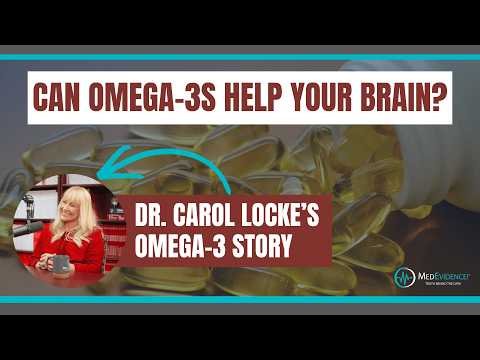
Can Omega-3s Help Your Brain? What the Research Really Shows
Audio
What happens when a Harvard-trained psychiatrist follows the evidence beyond traditional medicine?
In this episode of MedEvidence, Dr. Michael Koren sits down with Dr. Carol Locke, physician entrepreneur and Chief Science Officer of OmegaBrite, to explore her remarkable journey from psychiatry and academic research at Harvard’s McLean Hospital to pioneering evidence-based omega-3 innovation.
Dr. Locke shares how clinical research into mood disorders led to surprising discoveries about omega-3 fatty acids, brain health, inflammation, stress response, and emotional resilience. Together, they break down the science behind omega-3 balance, the role of EPA and DHA, third-party testing, and what clinical trials reveal about omega-3 supplementation’s impact on mood, anxiety, inflammation, and overall wellness.
You’ll also hear insights on physician entrepreneurship, innovation in nutraceutical science, and why evidence-based quality matters when choosing supplements.
In this episode:
- How omega-3s influence brain function and mood
- The link between inflammation, stress, and mental health
- What clinical trials reveal about omega-3 supplementation
- Why supplement purity and testing matter
- Emerging science on omega-3 delivery to the brain
- Advice for physicians pursuing innovation
Dr. Carol Locke has generously provided our audience with a 20% discount code "medevidence" for use at https://omegabrite.com/. Please note that MedEvidence does not receive any commission, compensation, or financial benefit from the use of this code.
|
|

References:
Omega-3 fatty acids in bipolar disorder: a preliminary double-blind, placebo-controlled trial
A. L. Stoll, W. E. Severus, M. P. Freeman, S. Rueter, H. A. Zboyan, E. Diamond, K. K. Cress, L. B. Marangell
https://pubmed.ncbi.nlm.nih.gov/10232294/
Omega-3 fatty acid monotherapy for pediatric bipolar disorder: a prospective open-label trial
https://pubmed.ncbi.nlm.nih.gov/17258897/
Psychoeducational Psychotherapy and Omega-3 Supplementation Improve Co-Occurring Behavioral Problems in Youth with Depression: Results from a Pilot RCT
Andrea S. Young, L. Eugene Arnold, Hannah L. Wolfson, Mary A. Fristad
https://pubmed.ncbi.nlm.nih.gov/27604240/
Omega-3 supplementation associated with improved parent-rated executive function in youth with mood disorders: secondary analyses of the Omega 3 and Therapy (OATS) trials
Anthony T. Vesco, Andrea S. Young, L. Eugene Arnold, Mary A. Fristad
https://pubmed.ncbi.nlm.nih.gov/29063592/
Omega-3 supplementation lowers inflammation and anxiety in medical students: a randomized controlled trial
Janice K. Kiecolt-Glaser, Martha A. Belury, Rebecca Andridge, William B. Malarkey, Ronald Glaser
https://pubmed.ncbi.nlm.nih.gov/21784145/[6]
Omega-3 supplementation lowers inflammation in healthy middle-aged and older adults: a randomized controlled trial
Janice K. Kiecolt-Glaser, Martha A. Belury, Rebecca Andridge, William B. Malarkey, Beom Seuk Hwang, Ronald Glaser
https://www.sciencedirect.com/science/article/pii/S0889159112001183
Omega-3 fatty acids, oxidative stress, and leukocyte telomere length: a randomized controlled trial
Janice K. Kiecolt-Glaser, Elissa S. Epel, Martha A. Belury, Rebecca Andridge, Jue Lin, Ronald Glaser, William B. Malarkey, Beom Seuk Hwang, Elizabeth Blackburn
Omega-3 supplementation and stress reactivity of cellular aging biomarkers: an ancillary substudy of a randomized, controlled trial in midlife adults
Annelise A. Madison, Martha A. Belury, Rebecca Andridge, Megan E. Renna, M. Rosie Shrout, William B. Malarkey, Jue Lin, Elissa S. Epel, Janice K. Kiecolt-Glaser
https://pubmed.ncbi.nlm.nih.gov/33875799/
Oberlies, N. H., & Kroll, D. J. (2017). Targeting cancer metabolism: A review of metabolic pathways and therapeutic opportunities. Frontiers in Pharmacology, 8, 339. https://pmc.ncbi.nlm.nih.gov/articles/PMC5397211/
Hölscher, M., & Krull, R. (2006). Mass transfer and diffusion limitations in biofilms. Water Research, 40(18), 3473–3484. https://doi.org/10.1016/j.watres.2006.07.016/
Transcripts
Transcript generated by AI
Announcer 0:00
Welcome to MedEvidence, where we help you navigate the truth behind medical research with unbiased, evidence-proven facts, hosted by cardiologist and top medical researcher, Dr. Michael Koren.
Dr. Michael Koren 0:11
Hello, I'm Dr. Michael Koren, the executive editor of MedEvidence. And I have a lot of fun in my job. I get really an opportunity to do some neat things. And today is one of those times where I have the opportunity to interview somebody who I've known for many, many years. I've seen her career develop over time. I'm incredibly proud of her in terms of her career. And I want to talk about her career path so that other people can appreciate it. So I'm going to welcome to MedEvidence Dr. Carol Locke.
Dr. Carol Locke 0:41
Hi.
Dr. Michael Koren 0:41
Carol, thank you for being part of our MedEvidence family. And thanks for being somebody I've known for 40 plus years. Is it around 40 years? Yeah, around 40 years.
Dr. Carol Locke 0:50
Pleasure to be here.
Dr. Michael Koren 0:51
Well, thank you. So just by way of introduction, Carol is a trained psychiatrist who got involved in the nutraceutical industry and became a physician entrepreneur. And Carol actually has a very interesting background that preceded the time when we met at Harvard Medical School. So, Carol, why don't you tell us about how you got to Harvard Medical School? You had a really interesting career prior to medical school, traveling around the world and doing some neat things. And I think that probably influenced your career path. So just tell us a little bit about you.
A Nonlinear Path To Medicine
Dr. Carol Locke 1:26
Well, I didn't expect to go to medical school.
Dr. Michael Koren 1:35
And you grew up in California.
Dr. Carol Locke 1:37
Grew up in California. So that changed things and then went to community colleges and then transferred to Berkeley and kind of got back on track and then studied anthropology and became interested in what is the meaning of health? What is health? How do we create it? How do we experience it? And at Berkeley went to the Fiji Islands and in a village there really focused on what what is the meaning of health in that village, which really was something we understand more now, but it was about social connection and the ability to be part of the community.
Dr. Michael Koren 2:16
And you lived there for a while. Yeah.
Dr. Carol Locke 2:18
So seven months, and then I went back for a month right before starting medical school. And that was a really good grounding before going into biological medicine and medicine as pathology. So that really stayed with me. And then we knew each other from medical school and went into psychiatry when I graduated, did my residency.
Dr. Michael Koren 2:48
And tell us where you're trained.
Dr. Carol Locke 2:49
At McLean Hospital at Harvard, and then stayed on faculty there.
Dr. Michael Koren 2:53
Yeah. So and you were there for quite a while.
Dr. Carol Locke 2:56
I was there for 12 years and during that time became involved in studying mood disorders, was the chief resident of the mood disorders my last year, and really looking at how mood disorders are treated. I was involved in research on bipolar disorder and looking at how the mechanisms of action for mood stabilizers and what else in nature might share that, which exposed omega-3 fatty acids.
Dr. Michael Koren 3:27
Yeah, and you identified some gaps that got you really interested in maybe looking at different ways of treating patients.
Dr. Carol Locke 3:33
Right. And how, you know, there's a lot of difficulty in bipolar disorder and depression, and also in the side effects of meds and people not feeling quite themselves. And so in this small study on bipolar and using omega-3s, the study was positive result. And what was unusual was people wanted to stay on the omega-3. And you you really don't often get people with bipolar saying, Let me stay on that study drug. Because they they often experience side effects or don't feel quite themselves or feel dampened. So in this case, two people contacted me saying, How can we stay on it? There wasn't anything. And another said, I feel like I have access to myself. And that really, Michael, stuck with me because it was so unusual.
Omega-3 Basics And The Omega-6 Balance
Dr. Michael Koren 4:36
Right. So we're let's take just in a little scientific aside. This is not hardcore scientific program, but explain to people a little bit about what you mean by an omega-3 fatty acid.
Dr. Carol Locke 4:48
Okay, so omega-3 fatty acids are essential fatty acids that our body doesn't make. So we have to get them in our diet, and we get them primarily. We can get an eight, they're fatty acids, their chains of carbons, and the 18 chain of omega-3 is in is in like flaxseed and in plants, but not everybody can elongate that to the 20 chain and 22 chain, which is EPA, icosapentenoic acid, and DHA, docosahexanoic acid. So those DHA and EPA are typically gotten from marine sources. So fish, fish oils, they come from algae, the the fish eat the algae and concentrate them. And we're trying in the industry to develop better algae sources with pretty good ones for DHA, but developing ones for EPA is harder.
Dr. Michael Koren 5:46
Yeah, so interesting. And and those different chains and where the double bond falls in have different biological effects.
Dr. Carol Locke 5:53
Yes. So you hear about, you know, you often hear about omega-3s in conjunction with omega-6. So you hear nowadays, don't eat seed oil, right? Seed oil is inflammatory. That's typically because of the omega-6 in seed oil, which has arachidonic acid. Arachidonic acid is a molecule that is a is a positive molecule. We can't live without it. We need to take it from our diet. And it is responsible for inflammation. So our inflammation is a good thing. We need to be able to respond. If we get an injury, an infection, we need our white cells to rush there. We need all of that to happen. But when we have a very high omega-6 level, we have a pro-inflammatory state.
Dr. Michael Koren 6:42
This is a balancing act.
Dr. Carol Locke 6:44
Yeah, so it's the omega-6, omega-3 balance. After the agricultural revolution, we had grain-fed animals, you know, grain-fed chickens, we grain oils, and so we had a huge amount of omega-6 come into our diet. That's not how we evolved.
Dr. Michael Koren 7:01
Right. So we need more omega-3s to balance the omega-6s.
Dr. Carol Locke 7:04
Right. So that we have so our body can naturally pull what it needs. So if it needs to be inflamed, it it ramps that up. If it needs to be in a normal, low inflammatory state, it can remain there.
Dr. Michael Koren 7:17
That is Super interesting. Yeah. Fascinating. We can go on for hours about the biology, but we're going to move on to things that I think are equally as interesting.
Turning A Study Into A Company
Dr. Michael Koren 7:26
And what I want you to share with our audience is your path. How'd you become a physician entrepreneur? I know you meant you're at McLean Hospital, an academic psychiatrist for a while, and now you are running a nutraceutical company. So tell us that pathway. That's amazing.
Dr. Carol Locke 7:41
Well, this is very unexpected. Very unexpected. I had no intention of that. But after this study, when people were saying, where can we take this? I feel normal. This must be what it feels like to be normal. I was really deeply struck by that. And when you're doing the research, you're working with the omega-3 companies that actually distill the oil and are making it to what you want. So I'm in medicine in my I had a full-time practice, three children in research, and then you're
Dr. Michael Koren 8:17
You put your children in research?
Dr. Carol Locke 8:18
Well, actually, I did.
Dr. Michael Koren 8:20
That's why they came out so good.
Dr. Carol Locke 8:21
I tested, I tested the omega-3s on them, actually.
Dr. Michael Koren 8:25
But even though it's a good thing. But uh sorry to get off track there, but keep on going.
Dr. Carol Locke 8:36
So I was kind of in these worlds, but I when I heard these patients say that, and then we started to get calls and requests, you know, and it spread through the depression in the bipolar networks. People wanted to go on it. And because it it's a healthy thing, it increases your health and it doesn't have these side effects, but people were reporting benefits.
Dr. Michael Koren 9:02
So how did you transition from that to like a structured company. You mentioned to me, I think, that you work with different people that actually find the fatty acids and purify them in certain ways, and it's the right balance of these things. So tell me what you're talking about.
Dr. Carol Locke 9:17
So I thought, well, I could make it for them because I had access to these distillation companies.
Dr. Michael Koren 9:23
Okay.
Dr. Carol Locke 9:23
And I could make not only what they want, but I could make, in my opinion, based on kind of first principles of what we knew in science, what I thought they needed most, the formula that I thought would work best. And I thought I could make a company. The internet had just happened, so I thought I could make a company. I didn't want to build a giant brick and mortar company. So I thought I could be in the center and we could control the distillation, we could bring in a new level of testing to nutraceuticals. So as a physician, I wanted it tested before, I wanted the specs, I wanted it tested after, and then I wanted it tested in the final product before it goes to the customer. So as a physician, I felt I really feel it's an honor. If you're making something people take in their body, you want it to be correct and safe in exactly what you you think. I mean, your company is built on that too. And so I designed this company where where we would be at the center and we would control all of this production all the way around.
Dr. Michael Koren 10:33
And you started this while you were still seeing patients at McLean?
Dr. Carol Locke 10:36
Yeah.
Dr. Michael Koren 10:37
Wow. And had the and three kids.
Dr. Carol Locke 10:39
And I was on maternity leave with my my youngest.
Dr. Michael Koren 10:42
Oh my goodness.
Dr. Carol Locke 10:44
And so I just I think that part of being an entrepreneur is this indefatigable optimism of well, you can just do it.
Dr. Michael Koren 10:56
Absolutely.
Dr. Carol Locke 10:57
And I I
Dr. Michael Koren 10:58
super cool.
Dr. Carol Locke 10:59
That's just what you kind of have is well, there's a need, so they need it, and I can make it. And I I remember having dinner with David Horbin, who's also in research. He's passed away now, but he's like, Why don't you do a drug? And I said, if if we go for a drug, it will be 12 years, maybe, maybe it'll come out, maybe it won't, but it'll be a long pathway. And these people need it now. It's a supplement, we can make it. And that was the path I chose.
Dr. Michael Koren 11:28
Move the needle more quickly. Yeah. Cool,
What Makes One Omega-3 Different
Dr. Michael Koren 11:31
very cool. So, Carol, tell us how OmegaBrite is different than other products on the market. As I understand it, there are quite a few omega-3 fatty acid supplements, and help me understand better why yours is different.
Dr. Carol Locke 11:46
Well, the omega-3s can come from different sources from the omega-3s, whether it's plant, whether it's algae, whether it's fish, what kind of fish, small fish which are small in the food chain and low in any contaminants, big fish such as tuna, uh, and so those the source is one differentiation in omega-3s. And then the type of omega-3 in the product, what what is your your balance of EPA and DHA? Because that really affects how the product works in your body. Different omega-3s have different actions, and the ratio and the amount actually matters.
Dr. Michael Koren 12:31
So a lot of the studies and you've sweated all these details.
Dr. Carol Locke 12:35
Yeah, so a lot of the studies are confounded because they're like, well, some is 20% EPA and some is 90% EPA, and they're all mixed together. So they're kind of mixed up. But so we make our product from the 7010 MD product, it is made from the smallest fish off the coast of per Peru and Chile, so they're in cold waters to keep the contamination low. We choose that rather than tuna because tuna is a big fish, has high contaminants. People worry about mercury. Mercury stays with the protein, it doesn't come into the oil. But we also distill in different ways to really pull the omega-3 away from anything and purify it in multiple ways. So you have the source that you want to do, select from, and then you have different distillation paths and different tests and how far you take it for purity. And we we then differentiate by making a very specific omega-3 ratio of 70% EPA, 10% DHA, and in a very high concentrate, so a 90% concentrate, which is very unusual. And then you treat it and protect it from oxygen so it doesn't have an aftertaste.
Dr. Michael Koren 13:57
So a lot of work's done to make it unique compared to other products. So eventually you moved on from practicing psychiatry to full-time focus on this business.
Dr. Carol Locke 14:06
Well, I I kept a consulting arm because just sort of feel like Are you seeing patients now? Yeah. So I'm I just moved here from from California. But I'm in Florida. But I still have my California license and I'm in the process of
Dr. Michael Koren 14:23
Oh, so you're doing over-the-phone consulting type thing? Virtual consulting. Okay.
Dr. Carol Locke 14:27
And I go back periodically.
Dr. Michael Koren 14:29
And How much of your time do you spend with consulting?
Dr. Carol Locke 14:32
I would say maybe 15%. Not not a lot, but enough to feel like
Dr. Michael Koren 14:37
still feel like a doctor.
Dr. Carol Locke 14:38
Yeah. You want to see people, you want to help people. Sure. You want to make a
Clinical Trials On Stress And Inflammation
Dr. Carol Locke 14:43
difference.
Dr. Michael Koren 14:43
So the other thing I was really impressed by is that you actually authorized an outside company to test your product. I thought that was fascinating. Most nutraceutical companies don't want to do that. Now, we do clinical research through MedEvidence, and during my sort of day job as a cardiologist, a research cardiologist, but we find that most nutraceutical companies don't want to go through the scrutiny of evidence-based medicine and clinical trials. But you approve that. And you approved that, and it turned out to produce some pretty interesting results. So, one, were you crazy? Why'd you let an outside party test your drug or trust your product, I should say? And two, tell us about the results.
Dr. Carol Locke 15:26
Well, it didn't occur to me not to, because my interest was how can this help? How can we better understand how it works? I'm hearing all of this response from people taking it, and I was, you know, had my hypotheses of how it would work as inflammation being a real driver of neuroinflammation and mood disorders. And what would we learn? And so it didn't actually ever occur to me to not do it. I was first asked by Mass General to provide product, the Omegabrite 7010, for a study in children in bipolar disorder. And they designed a study that was open label, and the clinician could decide how much to give. That was fascinating. They had just studied Olanzapine and risperdal, and they were doing kind of a similar study with OmegaBrite, and that showed actually a beneficial result in mood, in reduction of mania, and positive health response. And so that was fascinating. And then Ohio State had heard about our product and asked us if we we would plus provide placebo and control.
Dr. Michael Koren 16:50
That was a randomized placebo-controlled study.
Dr. Carol Locke 16:53
Yeah, so they did a number of those funded by connections.
Dr. Michael Koren 16:57
Congratulations. It was very exciting. I I mean it, you know And they studied it with a validated psychological scale, as I recall.
Dr. Carol Locke 17:05
Yeah. So they did a number of studies. They did two kind of different sets. They did studies in bipolar youth with studying it with therapy and looking at bipolar youth and depression and cohorts with ADHD. And that was fascinating. And again, you're, you know, it wasn't overnight. None of these, they're like, can you supply the placebo control? And then five years later,
Dr. Michael Koren 17:33
yeah, of course. Takes years to do. Yeah.
Dr. Carol Locke 17:35
You have nothing to do with it. And then you get a call, we're going to press, and here's the free press.
Dr. Michael Koren 17:41
Oh my goodness.
Dr. Carol Locke 17:42
And so really exciting. Very proud. And then it's kind of a dream come true because you know, you're you're a physician, but you're suddenly in making a product, but you're not in the research, in a sense. So suddenly you have this, these fantastic, these are world-class, you know, researchers that discovered how inflammation affects our immune system, how it affects one of them. She discovered, you know, how immunity, how stress affects our immunity. And Elizabeth Blackburn at UCSF won the Nobel Prize for discovering telomerase. To have them studying our product was so cool. Really exciting. And the results were very exciting to see it reduced inflammation, reduced IL-6, tumor necrosis factor, reduced serum cortisol. These are in healthy adults. It reduced the inflammatory response in response to a stressor. In healthy medical students, they studied it, and these are again controlled trials. It reduced anxiety by 20% and also IL-6. So and then it protected telomerase. They had a stress reactivity study where they put people into public speaking stress. And those on the Omega Brite, their telomerase was protected.
Dr. Michael Koren 19:13
And that's a trade name for your form of the .
Dr. Carol Locke 19:15
Yeah, so omega-3, omega. The high EPA omega-3 was protected against a drop in their telomerase. And then those that had the high omega-6 level, so they broke it up, they said, okay, well, some people probably came into the study taking omega-3s. They have a low omega-6 level, but for people who came into the study with a high omega-6 level, a high inflammatory balance, how did their telomeres do? And in those people that had high omega-6, for every amount their omega-6 dropped, the telomer length went up. So it actually was able to add base pairs.
Dr. Michael Koren 19:54
Interesting.
Dr. Carol Locke 19:55
So it was pretty amazing to have these researchers.
Dr. Michael Koren 20:00
Would you say a fair conclusion is that if you have high omega-6 levels, you're probably going to be most likely to benefit from omega-3 supplementation? Is that a fair statement?
Dr. Carol Locke 20:12
I think you definitely will, but you're not limited to that because in the other arms of the study, those that had lower omega-6 levels still responded with the reduction of IL-6 tumor necrosis factor and the reduction in serum cortisol.
Dr. Michael Koren 20:32
Were there differences between people who started with high versus low omega-6 levels or not particularly?
Dr. Carol Locke 20:37
The biggest difference was in the the telomere length.
Dr. Michael Koren 20:40
Okay.
Dr. Carol Locke 20:41
Then they they had the whole group responding to
Dr. Michael Koren 20:45
How about anxiety? You mentioned that as one of the markers that you looked at. Was that uh different they looked at was that different in people based on their baseline inflammatory uh lesson?
Dr. Carol Locke 20:57
I would have to look into that. Okay. Um the it showed that it was a 20% drop in anxiety of test taking. They viewed them as in a high stress environment. These were healthy medical students. So in these two studies, with what Janice told me is that with healthy medical students, they figured nothing would affect their inflammatory balance because they are healthy and they were surprised that it could still bring it down. And then they were also surprised, she said, very surprised in the middle-aged, overweight, sedentary adult population that didn't have a known medical disease. They felt like with being sedentary and overweight, as you know, that's an inflammatory factory. You have a lot of fat around the middle that's producing a lot of inflammatory molecules. And so they felt nothing was gonna move the needle there. They were very surprised there. that a supplement could bring it down. So I remember her calling me and just saying we we really didn't think this would make a difference. So very well thank you.
Dr. Michael Koren 22:11
Thank you for sharing that. And we will have some show notes that give connections to those references. So people want to dig in a little bit more the opportunity to look at the details.
Third-Party Testing And Label Accuracy
Dr. Carol Locke 22:21
Yeah.
Dr. Michael Koren 22:21
And I understand you've been a pioneer on third party testing of the purity of your product, which was not actually done prior to involvement in the industry. Maybe you can mention something about that.
Dr. Carol Locke 22:34
That's that's a important point. That's a real passion of mine and coming from medicine, making something my belief is was that in commitment was that it if you're going to provide something people take, you need to test it when it's made and then right before it goes to the consumer after it's then encapsulated. But you need to prove what you make is exactly what you're telling the consumer. And that really was missing from the nutraceutical industry. For example, entire countries were having problems. Australia went through a period where none of their fish met label claim. So what it said on the label none of it included that. So it's a big passion of mine in our companies that it should always meet label claim or exceed it and really to raise that in the industry. Our company did that from the start we were awarded for for raising the levels of of purity and concentration in 2007 and we're very proud of that. And now it's really come up and GMP standards have come up and the industry's really improved. But it's a constant challenge and I think it's really important for consumers to look for third party testing. Products should be able to supply you with a test for any batch give them a sense of confidence and the commitment of the manufacturer to quality. Right because all kinds of products can have contaminants whether they're plant based they could have lead in them. You know it's just really important if you're going to take it into your body you want it to be pure.
Dr. Michael Koren 24:26
So thank you for that obsessive compulsive approach to quality we love that.
Dr. Carol Locke 24:30
Yeah.
Mood Support And Brain Delivery Breakthroughs
Dr. Michael Koren 24:31
So tell me what you do now day to day in terms of getting the word out about your product.
Dr. Carol Locke 24:36
Well now I am involved as the chief science officer and and we just doing more speaking on it. I'll be at the APA American Psychiatric association show in San Francisco in May and we'll be doing a talk there on omega 3s and mood and how to provide mood support. We really would like to support people's awareness especially with children because there's a mental health crisis in kids and a much higher since the pandemic level of depression and anxiety that really bringing their baseline of omega-3 up could provide support for their mood, support for their neurodevelopment and a a better baseline and potentially help them be more resilient during these times. So we'd like to to really get people aware of that as well as people of all ages that using omega 3s can be a very powerful way to support your managing not just mood brain health but also inflammation and your your managing of stress. So we're excited about that and we we just launched a new product that super excited about which is it's not a new form of omega 3 but it's a new discovery of how omega 3 is transported into the brain we know that the brain needs omega 3 some areas are 30% DHA in the cell membrane. But how is it getting in it's not all getting in in diffusion so in 2014 the MFS D2A receptor or transporter was discovered and that transporter ferries omega 3 across and flips it into the brain. So Ocker Biomarine then was able to concentrate krill oil and treat it with an enzyme to create this lysophosphatidocholine molecule and we've just launched that as our LPC brain elite molecule and that gives people a way to to replenish DHA into the brain also into the retina and across the placenta. So really excited there's you know populations that have lower DHA in the brain they want to increase it as we age we have less DHA and in the eye so it's really exciting.
Dr. Michael Koren 27:08
I love it good luck with all that's amazing really really super interesting. And I hear you have another international claim to fame. In fact you're responsible for an international holiday did I hear that correctly I'm not sure it's a holiday but I would like it to be okay well tell us about that.
International Omega-3 Day And A Charity Vision
Dr. Carol Locke 27:27
My family and I in 2000 actually starting in 2009 but the first one was 2010 launched International Omega 3 Day as a really a day on the science of omega 3. I really believe the benefits of omega 3 are are extraordinary and people need to know and we we launched that it was a global day inviting scientists and clinics and uh around the world to share omega-3 evidence and the how it can work in the body and provide benefit. And that then continued we we had our initial launch with Bill Harris who uh with Von Shacke created the Omega 3 index which people can test their red blood cell level John Rady who is well known in ADHD as well as Exercise in the brain and other researchers we launched it featuring them and now it's been taken on by the Goed, the global organization of EPA and DHA so now it's it's so what date on the calendar March 3rd so March third omega threes or three so I picked three three
Dr. Michael Koren 28:42
I love that I love that
Dr. Carol Locke 28:43
and then with that our family also created an an omega three charity which we hope to sponsor omega threes get the companies to donate so that there can be omega three sources for say women pregnant women because say in in pregnancy it really reduces preterm birth it has tremendous benefits for for the baby. So we are you know there's other other uses in mood for children and adults it would be nice to have a charity where the different companies are donating and somehow we can make that available to people.
Dr. Michael Koren 29:27
Okay. So here's a crazy thought you've mentioned a lot about consuming omega 3s. How about putting omega 3s on your skin are there any data showing that cutaneous exposure to omega 3s have as has some effect?
Dr. Carol Locke 29:42
I think that that's a good question. I have to look up more I think that with the marine ones because when omega 3 oxidizes it smells bad uh fishy so you have to protect it from oxidation. It's very important for skin but that's a good question. I wonder where that is right
Dr. Michael Koren 30:05
so I shouldn't start bathing in it quite yet
Dr. Carol Locke 30:07
unless you want to like attract a shark.
Advice For Physician Entrepreneurs
Dr. Michael Koren 31:01
So last question what advice do you have for other physician entrepreneurs that may have made discoveries in practice and want to express themselves in the ways that you learned to express yourself?
Dr. Carol Locke 31:15
I I think it's just if you have something that you think is going to help people then go forward with it and do it. I think the world is much more accustomed to that now in medicine. When I did it and launched the Omega 3 company Omega Brite people were like what are you doing? You know and this isn't just strict medicine and it was hard. But I really believe this we need to make this available to people we need to make not just fish oil but particular omega threes that can help because there's different omega threes for different purpose so if you have something that you believe can help people then do it because it's just by doing it you make it real.
Dr. Michael Koren 32:04
That's great. I love that Carol thank you so much for being part of MedEvidence. This information has been invaluable I've learned a lot and hopefully our viewers and listeners will have learned something as well. Thank you again.
Dr. Carol Locke 32:16
Thank you Michael
Announcer 32:17
thanks for joining the MedEvidence podcast to learn more head over to medevidence.com or subscribe to our podcast on your favorite podcast platform