
Gout Isn’t Purely a Problem of Passing Purine
As a relatively new parent, I deal with diapers - a lot. Good diapers can absorb a full toddler bladder without breaking a sweat (or a leak). My understanding of how they work is that they’re filled with special chemicals that can absorb massive amounts of liquid by growing in size to keep clothes clean and dry. Diapers absorb water, of course, but more importantly, they absorb urine. One of the critical components of urine is uric acid, which is usually found in the body in a slightly different form called urate. When there is too much urate in the body, we can’t hold it in, and it deposits in the joints. This triggers an inflammatory response known as gout.
Gout is the most common inflammatory arthritis, affecting around 4% of Americans.[1,2] It affects men at three times the rate of women.[2] It is autoinflammatory, meaning the immune system’s response to excessive urate in the body is what’s causing a significant amount of the damage.[1] Not everyone with excessive urate progresses to inflammatory gout, and in fact, around ⅕ of Americans have high urate levels in their blood (“hyperuricemia”).[2]
Risk factors for developing gout include:[1]
- Age
- Being male
- Medical conditions like metabolic syndrome, chronic kidney disease, psoriasis, and blood cancer
- Medications like diuretics
- Obesity
- Eating foods high in purines or which increase purines, including alcohol, seafood, meats, and fructose
…but what are purines, and why do they increase urate and our risk of gout?
Purines are chemical compounds that come in many useful forms, from components of our DNA to caffeine. Most mammals can break down purines to make other compounds used in the body, but humans (and a few other primates) have a genetic tweak which makes us unable to process purines fully.[3] For us, purine metabolism stops at urate, which is why we can get hyperuricemia. At normal concentrations in the blood, urate is a useful antioxidant, blood pressure regulator, and immune signal.[1] At high concentrations, however, urate can start causing problems, especially with the immune system.[1]
Progressing from high urate to gout is a staged process. Most people have normal urate levels, and those that don’t may either produce (or consume) too much urate or get rid of too little.[1] Urate is filtered out by the kidneys, but the protein human urate transporter 1 (URAT1) reabsorbs almost all of the urate back into the bloodstream.[1,3] URAT1 isn’t the only transporter, but it is responsible for the lion’s share.[4] This process keeps urate levels in a healthy homeostasis for most people, unless they have an overactive URAT1 protein, a defective kidney, or some other condition which disrupts the homeostasis.[4] Hyperuricemia is a necessary, but not sufficient, step on the path of gout.[1]
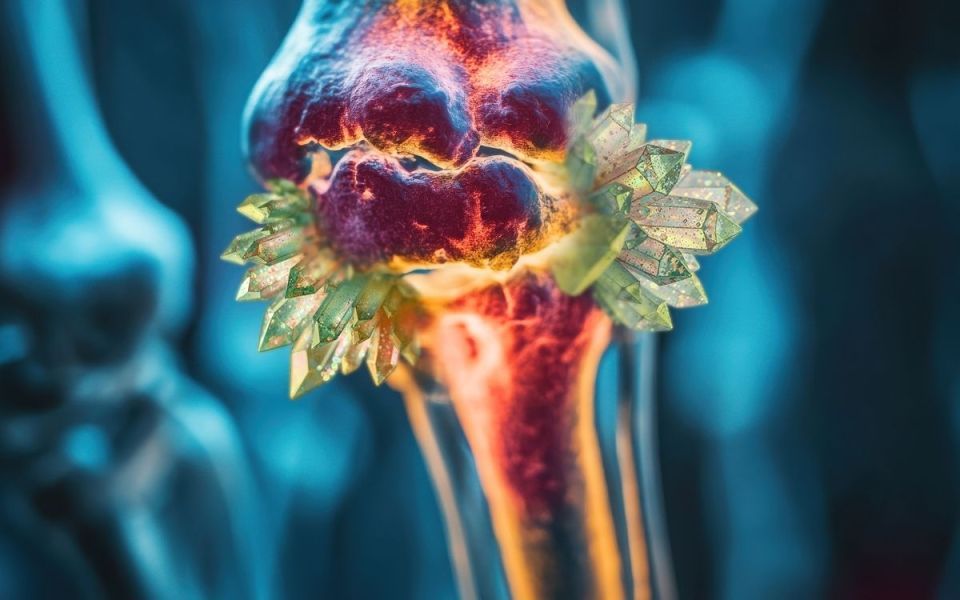
When there is too much urate in the blood, it can move from dissolved ions into solid crystals called monosodium urate (MSU).[1] These crystals deposit where low temperature and high sodium reduce MSU solubility: the peripheral joints, especially toes.[1,5] These crystals can cause physical damage, grinding the bones, and can also initiate an immune response.[1,6] Remember earlier where we said one of the functions of urate is as an immune signal? Urate is released when cells die, and attracts immune cells to investigate, clean up, and cause inflammation.[6] For some people MSU deposits also attract immune cells, which infiltrate joints and cause inflammation.[6] It’s unclear why this only happens for some people, but they may have more active or higher base levels of pro-inflammatory molecules.[1,6] For a small portion of particularly unlucky patients, immune cells will surround MSU crystals and swell like a full diaper.[1,5] This can cause a cycle of chronic inflammation and create a hard stone-like deposit called a tophus.[1,5]
So how do we stop the flow of gout? For many people, a combination of lifestyle and medical changes may help. For obese patients, weight loss is associated with positive outcomes.[1] Gout-specific diets may prove beneficial, though should be discussed with a physician and/or dietician.[7] Low purine diets tend to be unpalatable, low in protein, and high in fats and sugars that can make cardiovascular outcomes worse.[1] A DASH (Dietary Approaches to Stop Hypertension) diet, which prioritizes vegetables, fruits, low-fat dairy, and whole grains and discourages salt, sugary drinks, and red or processed meats has some evidence of success with gout and avoids exacerbating heart problems.[5]
Medical treatments like fenofibrate (a cholesterol medication) are associated with significantly lower urate levels, but only ⅓ of people with gout are using urate‑lowering therapies.[2] Part of the problem may be that urate-lowering therapies can take more than six months to be effective.[7] Other medications like colchicine, NSAIDS, and corticosteroids target pain.[7] Clinical trials are evaluating new methods of targeting the underlying systems that cause gout. The CANTOS trial, a heart disease study evaluating a medication that targets an inflammatory molecule. This molecule is also culpable in gout inflammation, and the CANTOS trial found a 50% reduction of gout flare-ups as a “side effect!”[1] Other clinical research is looking at URAT1 inhibitors in an effort to help reduce urate in the blood and make the kidneys more efficient at removing the inflammatory signal.[4,8,9] Early results from this trial look promising.[9] With the help of clinical trials, gout sufferers may be able to avoid the worst parts of this painful disease, much like I avoid diaper duty whenever I can.
Creative Director Benton Lowey-Ball, MWC, BS, BFA
|
|

References:
[1] Dalbeth, N., Choi, H. K., Joosten, L. A., Khanna, P. P., Matsuo, H., Perez-Ruiz, F., & Stamp, L. K. (2019). Gout (primer). Nature Reviews. Disease Primers, 5(1).
[2] Chen-Xu, M. (2018, October). Contemporary prevalence of Gout and Hyperuricemia in the United States (National Health and Nutrition Examination Survey [NHANES] 2015-2016) and decadal trends (NHANES 2007-2016). In 2018 ACR/ARHP Annual Meeting. ACR. https://pmc.ncbi.nlm.nih.gov/articles/PMC6536335/
[3] Benn, C. L., Dua, P., Gurrell, R., Loudon, P., Pike, A., Storer, R. I., & Vangjeli, C. (2018). Physiology of hyperuricemia and urate-lowering treatments. Frontiers in medicine, 5, 160. https://pmc.ncbi.nlm.nih.gov/articles/PMC5990632/
[4] Wu, C., Zhang, C., Jin, S., Wang, J. J., Dai, A., Xu, J., ... & Xu, H. E. (2025). Molecular mechanisms of urate transport by the native human URAT1 and its inhibition by anti-gout drugs. Cell Discovery, 11(1), 33. https://pmc.ncbi.nlm.nih.gov/articles/PMC11962085/
[5] Rai, S. K., Fung, T. T., Lu, N., Keller, S. F., Curhan, G. C., & Choi, H. K. (2017). The Dietary Approaches to Stop Hypertension (DASH) diet, Western diet, and risk of gout in men: prospective cohort study. BMJ, 357. https://www.bmj.com/content/357/bmj.j1794.abstract
[6] Kim, S. K. (2022). The mechanism of the NLRP3 inflammasome activation and pathogenic implication in the pathogenesis of gout. Journal of rheumatic diseases, 29(3), 140-153. https://synapse.koreamed.org/articles/1516078716[7] Qaseem, A., Harris, R. P., Forciea, M. A., & Clinical Guidelines Committee of the American College of Physicians*. (2017). Management of acute and recurrent gout: a clinical practice guideline from the American College of Physicians. Annals of internal medicine, 166(1), 58-68. https://www.acpjournals.org/doi/full/10.7326/M16-0570
[8] Suo, Y., Fedor, J. G., Zhang, H., Tsolova, K., Shi, X., Sharma, K., ... & Lee, S. Y. (2025). Molecular basis of the urate transporter URAT1 inhibition by gout drugs. Nature Communications, 16(1), 5178. https://www.nature.com/articles/s41467-025-60480-3
[9] Atom Therapeutics. (2025, September 8). Atom therapeutics announces positive topline results of Lingdolinurad (ABP-671) in phase 2b/3 trial for chronic gout. [Website, accessed December 1, 2025]. https://www.businesswire.com/news/home/20250908760583/en/Atom-Therapeutics-Announces-Positive-Topline-Results-of-Lingdolinurad-ABP-671-in-Phase-2b3-Trial-for-Chronic-Gout