
What Does Mouthwash Have to Do with Blood Pressure?
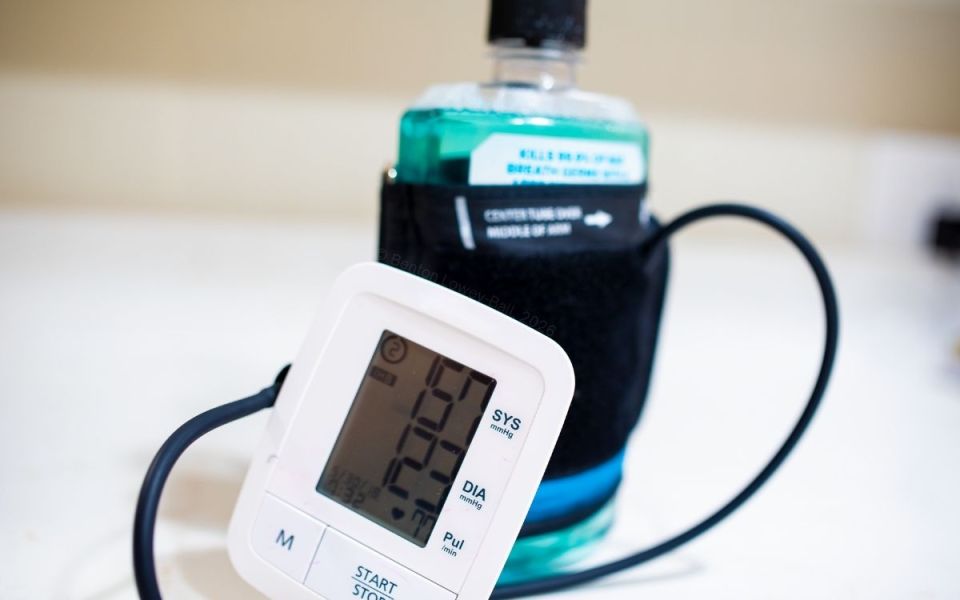
Have you ever wanted to see some human bones sticking out of the skin? Me neither, but did you know that you see this very sight each and every time you brush your teeth? Teeth are pretty awesome; they help us chew, eat, talk, and make that super loud whistle some people can do. Having our teeth bones exposed to the warm, wet, nutrient-rich place we call our mouths can present some issues, however, especially for those of us who consider a half-gallon of ice cream to be just two servings. The mouth hosts a diverse ecosystem over 700 different species of bacteria.[1] These bacteria vary from person to person, but for most people the bacteria (and fungi, viruses, and other tiny critters) form a symbiotic relationship with us and help break down food into useful particles.[1,2] For others, however, the makeup of bacteria is disturbed and dangerous; teeth-and-gum-destroying bacteria can dominate and cause big problems like plaque, periodontitis, and tooth decay.[1]
Regular brushing and flossing are the main ways to prevent cavities and gum disease, but many people also use mouthwash; around ⅔ of Americans use it at least once a week, and ⅓ use it every day.[3] Mouthwash can kill problematic bacteria that cause damage, but it’s a blunt (if wet) instrument.[1] Most mouthwash brands contain some kind of antibacterial: alcohol, chlorhexidine, essential oils, or cetylpyridinium chloride.[1] These indiscriminately kill bacteria, both bad and good.[1] Using antibacterial mouthwash is like setting your lawn on fire to fight weeds; the weeds might die but the grass is going to suffer as well. Also, after burning down your lawn (I’m told), once the damage is done you’ve got fertile ground for growing - and the weeds are likely to grow back first.[Personal experience as a child] So mouthwash can kill good bacteria, and doesn’t keep the bad ones away for very long, but that’s gotta be it, right?
Wrong. Mouthwash has been linked, weirdly, to increased incidence of high blood pressure![1,3,2] High blood pressure is one of the most common treatable, chronic conditions in America.[4] Around half of Americans have blood pressure above 130/80 mmHg, with men at higher risk than women.[4] High blood pressure isn’t itself a disease, but it is a major risk factor for heart attack and stroke, and one of the few that can be successfully treated. So, how does mouthwash lead to increased blood pressure? The answer is - even weirder - is laughing gas.
Laughing gas - properly known as nitrous oxide and abbreviated NO - helps regulate cell and tissue function.[5] Cells make nitrous oxide to help neutralize a harmful molecule called superoxide, reduce the effects of other reactive molecules, and regulate blood pressure (aha!).[6] Nitrous oxide is the critical initiator of a pathway that helps blood vessels relax, and studies have found that low levels of nitrous oxide in the bloodstream can increase blood pressure.[2,5,6] Cells produce nitrous oxide, but they need both something to produce it from and a signal to start production.[2,6] That’s where the mouth and mouthwash play a role.
Some of the chemicals digested by good bacteria in the mouth are nitrates, made of nitrogen and oxygen atoms.[3] Nitrates are found in things like bacon and preservatives, and oral bacteria break them down into either nitrite or ammonium.[2,3] Nitrite is a precursor to nitrous oxide and acts as a signal for cells to produce nitrous oxide.[2,3] Ammonium, on the other hand, is a waste product and is a significant ingredient in urine. The major problem with mouthwash, then, is that, in an effort to improve our oral health, we may be killing the good bacteria in our mouths.[3] Without those bacteria we can't break down nitrates, produce nitrites, or relax blood vessels, which can lead to high blood pressure.[3] Those who use mouthwash twice a day, every day, face a more than 100% increased risk of developing high blood pressure than those who do not use mouthwash at all.[3]
So, what should we do, ignore our dentists? Judging by the number of people who regularly floss, the answer to that appears to be a resounding “yes,” but that’s probably not the healthiest option. In fact, the solution is exactly the opposite! Physical removal of plaques by a dentist or oral hygienist, along with regular brushing and flossing, remains the gold standard of tooth care.[1] Talking to your hygienist, dentist, and primary care physician is a great way to learn if this is even an issue for you at all: many people just use mouthwash because it feels clean, not to fight any kind of mouth disease.[3] There may also be alternative solutions that you can discuss with your dentist, including prebiotics, probiotics, postbiotics, and personalized oral hygiene strategies.[1] With more research, we may be able to have fresh breath without the heartbreak (or heart attack!).
Creative Director Benton Lowey-Ball, MWC, BS, BFA
|
|

References:
[1] Angjelova A, Jovanova E, Polizzi A, Leonardi R, Isola G. Effects of antiseptic formulations on oral microbiota and related systemic diseases: a scoping review. Antibiotics. 2025 Aug 8;14(8):815. https://doi.org/10.3390/antibiotics14080815
[2] Morou-Bermúdez E, Torres-Colón JE, Bermúdez NS, Patel RP, Joshipura KJ. Pathways linking oral bacteria, nitric oxide metabolism, and health. Journal of Dental Research. 2022 Jun;101(6):623-31. https://doi.org/10.1177/00220345211064571
[3] Joshipura K, Muñoz-Torres F, Fernández-Santiago J, Patel RP, Lopez-Candales A. Over-the-counter mouthwash use, nitric oxide and hypertension risk. Blood pressure. 2020 Mar 3;29(2):103-12. https://doi.org/10.1080/08037051.2019.1680270
[4] Fryar CD, Kit B, Carroll MD, Afful J. Hypertension prevalence, awareness, treatment, and control among adults age 18 and older: United States, August 2021–August 2023. NCHS Data Brief, no 511. Hyattsville, MD: National Center for Health Statistics. 2024. https://dx.doi.org/10.15620/cdc/164016
[5] Sansbury BE, Hill BG. Regulation of obesity and insulin resistance by nitric oxide. Free radical biology and medicine. 2014 Aug 1;73:383-99. https://doi.org/10.1016/j.freeradbiomed.2014.05.016
[6] Pacher P, Beckman JS, Liaudet L. Nitric oxide and peroxynitrite in health and disease. Physiological reviews. 2007.
Reference Style changed from APA to AMA January, 2026